


The Essentials of Ethical Breeding: A Personal Perspective on Raising Devon Rex Kittens

Updated: Dec 4, 2025
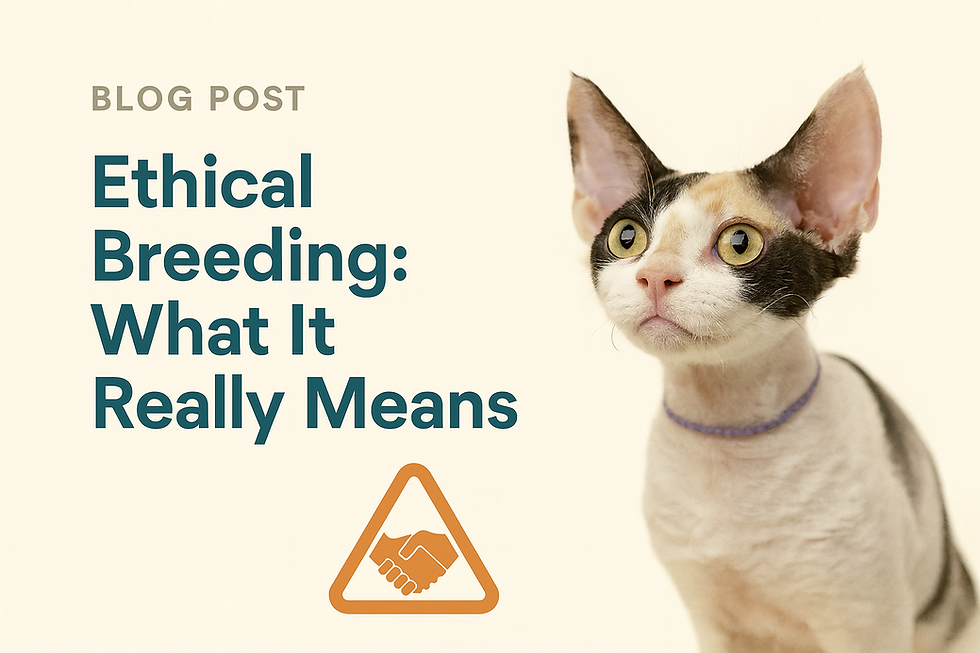
I’m a firm believer that no breeder is a “one size fits all.” My red flags may not be your red flags — and your red flags may not be mine. That’s the beauty of having a selection of breeders and programs to choose from. However, there are a few non-negotiable basics that all breeders should follow if they’re doing right by their cats, their buyers, and the breed. These are my standards, and more importantly — the reasons behind them.
1️⃣ Health-Focused Breeding
Kittens receive comprehensive veterinary care, including proper vaccinations, deworming, and regular checkups, to ensure they are healthy from the start. Breeding animals are carefully screened for overall health, temperament, and conformation, so only the strongest and most well-adjusted cats contribute to the program. These practices not only protect the individual cats but also help maintain the integrity and long-term health of the breed, giving buyers confidence that they are bringing home a healthy, well-socialized, and genetically sound companion.
2️⃣ Genetic Health Testing
This one is simple: there is zero excuse not to health test. Genetic testing is affordable — especially compared to the cost of treating or losing a cat to a preventable genetic disease. For example, CMS (Congenital Myasthenic Syndrome) can kill a cat before they reach five years old. Imagine spending over $2,000 on a kitten, only to lose them at five because the breeder was too cheap or lazy to run a $100 test. Let that sink in.
A vet health clearance is not the same thing as genetic testing. A veterinarian can confirm your cat is healthy right now — but they cannot tell you if your cat will develop kidney failure, heart disease, or another inherited condition down the road. Ethical breeders test, period.
3️⃣ Contracts and Health Guarantees
A solid contract is there to protect everyone — the breeder, the buyer, and most importantly, the cat. Contracts show that the breeder cares where their kittens end up and are willing to stand behind them. Life happens — jobs change, health changes, families move — and sometimes people can’t keep their pets.
A good contract ensures that if that happens, the cat comes back to the breeder, not into a shelter. It also holds the breeder accountable to you as the buyer. Without a contract or health guarantee, if your kitten gets sick or passes away, that Craigslist “breeder” will vanish faster than a fart in the wind.
4️⃣ Registration Papers
This one surprises a lot of people. Most pet owners don’t care about registration papers — they just want a healthy, happy kitten with a great personality. Totally fair.
But here’s what most don’t realize:
Registration isn’t about the paper. It’s about whether the breeder is doing things ethically.
To register a litter, the breeder must have legally purchased breeding rights for the parents.
If a breeder can’t or won’t register their kittens, it’s usually because:
The cats aren’t actually purebred,
or
The breeder is violating the contract they signed when they bought the parents.
And that speaks volumes.
If they're willing to break the contract with their own mentor breeder, what do you think they'll do when your kitten gets sick and you need help? Spoiler: nothing.
Ethical breeders use registration to protect the breed and maintain standards. They know which kittens are appropriate for breeding and which should be placed as pets — whether due to temperament, structure, or genetic considerations.
And let’s be honest… the cost excuse?
Nope. Not buying it.
It costs breeders roughly $15–20 to register an entire litter.
Even pre-registering and naming each kitten only adds about $15 more. That’s pocket change compared to the price of a kitten.
So if a breeder says they charge extra for papers or that registering “raises the price,” what they’re really saying is they don’t know what they’re doing — or they’re hoping you don’t.
Registration protects you, too. It proves your kitten is genuinely purebred, ensures the breeder followed ethical steps, and adds a layer of accountability.
Bottom line?
Even if you don’t care about the papers, you should care whether the breeder is honest enough to provide them.
5️⃣ Spay and Neuter Before Placement
This is one of the most important steps a responsible breeder can take. Fixing kittens before placement is healthier for the cat and safer for everyone involved. When complications occur (and they sometimes do), a breeder is far better equipped to recognize and address them. In my case, I’m a licensed veterinary technician. While working at an animal shelter, I oversaw the recovery of over 1,000 animals after surgery. Monitoring healing and spotting problems is second nature to me.
By spaying and neutering before they leave, I take on that responsibility — on my dime — and ensure that if something happens, it’s handled promptly and properly. It also ensures we don’t add to the shelter population through backyard breeding. In my first year and a half of living here, I was asked over 30 times if I offered stud service — and many of those people didn’t even own Devons. Ethical breeders fix their kittens because it protects their animals, their lines, and the breed’s reputation.
6️⃣ Microchipping
Microchipping is another layer of protection that every ethical breeder should provide. Most of the time, the breeder’s contact information remains locked as a backup on the microchip. That way, if something happens — you’re out of the country, unreachable, or in the worst-case scenario, pass away — your cat still has a safety net. This isn’t about control. It’s about responsibility. Ethical breeders microchip because they want to ensure their cats never end up lost, abandoned, or surrendered.
7️⃣ Animal Welfare Above Profit
Ethical breeding is fundamentally about putting the welfare of the cats above any financial gain. Every aspect of a breeding program — from the selection of breeding cats to the timing and number of litters — is guided by what is best for the animals, not by trends, market demand, or potential profit. Young kittens are carefully socialized, handled, and exposed to a variety of home environments to ensure they develop into confident, well-adjusted pets. Breeding cats live in clean, safe, and enriching spaces that cater to their physical and mental needs.
Ethical breeders also carefully screen potential homes, ensuring that kittens go to owners who can provide proper care, attention, and a safe environment, rather than simply selling to anyone with the ability to pay. Even when unforeseen expenses arise — emergency veterinary care, surgical procedures, or specialized nutrition — an ethical breeder absorbs those costs rather than compromising care to save money. Any income generated is reinvested directly into maintaining and improving the cats’ health, safety, and overall quality of life.
In short, ethical breeders prioritize healthy, happy cats, responsible placement, and long-term welfare over trends, popularity, or profit, ensuring that every decision reflects a genuine commitment to the animals’ lifelong well-being.
Beyond the Basics: What Makes a Breeder Truly Ethical (In My Opinion)
Now that we’ve covered the basics, here are some of my personal opinions on what makes a breeder truly ethical. These are areas where views can differ, but this is what I personally believe in and practice. The following are my personal beliefs — formed from decades in the cat fancy — on what separates a good breeder from an ethical one.
1️⃣ Number of Breeding Cats
This one is always subjective. I like to look at how many breeding cats a person owns, but I also take into account their setup and circumstances. For example, when my mom helped me get started with Devons, we operated under one shared name and website but ran two separate catteries at one time. On paper, it looked like a lot of cats — in practice, it wasn’t.
That said, if one single person is managing 15-20 or more cats on their own, that’s too many, in my opinion. There’s only so much one person can reasonably handle before the cats’ care and socialization start to suffer.
2️⃣ Number of Litters at One Time
I personally like to have at least two litters at a time. Some breeders and buyers may see that as a red flag, but here’s why I don’t: I've learned over the years, my Devon moms often love to co-parent. It helps new moms learn from experienced ones, ensures balanced milk supply, and prevents complications like mastitis in mothers with too much milk.
However, when I see a breeder with four or more litters at once — or litters back-to-back all year — I start to question whether those kittens are getting enough attention and socialization. Do they have room for all these litters, or are they being kept in sheds/kennels? Raising well-adjusted kittens takes time, and if someone is juggling multiple litters constantly, it’s easy to start cutting corners.
3️⃣ Breeding Frequency
Every breeder has their own comfort zone with litter frequency, and it truly depends on the individual queen. Over the years, I’ve noticed something surprising: spacing litters too far apart often leads to more birthing complications.
For my girls, the safest, most consistent rhythm has been 3 litters every 2 years. It allows them to cycle naturally, stay hormonally balanced, and recover well without being overbred. Some of my females do best being bred only once every 1.5 years, while others bounce back beautifully and are in excellent condition after raising a litter.
That said, I personally stick to the “3 per 2” rule and won’t exceed it.
And in my opinion — and many breeders would agree — certain patterns are clear red flags:
❌ Two litters every single year, year after year
❌ Three litters in one year
❌ No meaningful recovery time between pregnancies
Every cat is different, but ethical breeding always prioritizes the queen’s long-term health, not constant production.
4️⃣ USDA Licensed
“USDA licensed” sounds impressive — like the breeder is extra responsible.
But in the world of cats and dogs, it’s actually a red flag.
USDA licensing has nothing to do with ethical, small-scale, home-raised breeding.
It was created for commercial breeders who produce animals in larger numbers or ship them sight-unseen. The USDA treats these setups more like livestock operations, not family-raised companion animals.
And the standards? Minimal.
A USDA-licensed breeder can:
Keep large numbers of breeding animals
House cats in cages or kennel-like facilities
Breed back-to-back litters
Operate at high volume with little oversight
As long as the animals have food, water, and aren’t in visible distress, they pass.
There is no requirement for genetic testing, limited breeding, socialization, enrichment, or ethical guidelines of any kind.
In short:
USDA licensing usually means the breeder is running a commercial-scale operation — the opposite of ethical home breeding.
Ethical breeders don’t qualify for USDA licensing because they:
Produce too few litters
Raise kittens in their homes
Want to meet their buyers
Aren’t operating mills or large facilities
So when a breeder advertises “USDA licensed,” it’s not a mark of quality — it’s a warning sign of volume-based breeding, not thoughtful, health-focused practices.
It’s also important to note that some states, provinces, counties, or cities have their own local licensing requirements for any breeder — even small, ethical, hobby breeders with only one or two litters a year.
These local permits are not the same thing as a USDA license.
5️⃣ Kennel Housing
Breeding Cats Kept in a Separate Building
Another major red flag, in my opinion, is when a breeder keeps their cats in a separate building, barn, shed, garage, or “kennel house” instead of inside their actual home.
While it may sound organized or “professional,” what it really means is:
The cats are not being raised as part of the family
Socialization is limited
Daily interaction is reduced
Kittens grow up in an artificial, isolated environment
The breeder is managing cats in volume, not as individual companions
Cats raised in kennel-style setups often miss out on:
normal household noises
family bonding
handling and play
exposure to children, pets, and everyday life
the confidence and resilience that comes from being raised underfoot
This type of setup is especially inappropriate for people-oriented breeds like Devon Rex, who rely heavily on human interaction, daily companionship, and a warm indoor environment. Devons are sensitive to both heat and cold — they simply aren’t meant to live in outbuildings or temperature-variable spaces.
Ethical breeders raise kittens inside their homes because that’s how you produce stable, confident, well-adjusted companions. A separate “cat building” may look tidy, but it’s fundamentally commercial housing, not ethical, home-based husbandry.
If a breeder isn’t living with their cats, interacting with them daily, or raising kittens underfoot, ask yourself:
Are these cats part of their family — or part of their inventory?
6️⃣ The Term “Professional Breeder”
This phrase sounds reassuring — but I’ve learned to be wary of it. When someone says they’re a “professional breeder,” what that often means is that breeding is their only source of income. And while there’s nothing inherently wrong with dedicating yourself fully to your animals, it can put a person in risky situations when finances get tight.
If emergencies happen — say multiple cats need C-sections in a single year — the temptation to “breed their way out of the red” can be strong. That can lead to back-to-back breedings, using cats too young, or compromising on health or type just to have something to sell.
There are some who say breeders should make money for the time and effort they put into raising their cats — and I understand that point of view. But this is where opinions differ. I can’t raise cats to just give away, but I also don’t believe in making profit off my cat’s uterus. What money I make goes straight back into my cats — food, health testing, veterinary care, supplies, and improvements to their environment.
And if, by some chance, there’s a little left over one year, it doesn’t go into my pocket. It’s set aside for the following year, in case I end up back in the red — because in this work, that’s always a possibility. In 20 years of breeding, I’ve only had one year where my cattery wasn’t in the red. Corners must be cut to make a consistent profit — and that’s not something I’m willing to do.
7️⃣ Designer Breeding
This should be a given, but let’s talk about it anyway — because it’s becoming more common than ever. The most frequent example is munchkin mixes, though it happens across multiple breeds. According to breed standards, a Munchkin should only be bred to a domestic short- or long-haired cat. That’s because Munchkins need to be paired with a long-legged cat to avoid serious skeletal and bone defects.
Unethical breeders figured out that if they start adding other purebred cats into the mix instead of domestics, they can market these kittens as something “rare” or “exotic.” They play a numbers game — the more mutations, the more money they can charge. It’s a shortcut to profit. Not ethics.
The problem? These cats can’t be registered, don’t follow a standard, and are often not health tested. It’s cutting corners at every step, all for profit — and it’s the cats who pay the price. That’s not breeding to improve a breed — that’s breeding to fill a wallet.
8️⃣ Breeding Off-Standard or for Fad Traits
Another growing concern is breeders chasing trends. The Dominant Blue Eye (DBE) gene is a perfect example. It’s a trait that goes against the breed standard and is currently banned or under review by several cat associations worldwide due to potential health risks.
Despite that, people are still charging two to three times the normal price for these kittens. To me, that’s the definition of breeding for money — not for the betterment of the breed. If you want to buy a DBE kitten, that is your choice. But please do not buy from a breeder charging more than they would for their normal Devon Rex kittens.
9️⃣ Education and Ethical Standards
Ethical breeders are committed to continuous education and the improvement of their programs. They stay knowledgeable by keeping up-to-date on genetics, nutrition, behavior, and veterinary care, ensuring they make informed decisions for the health and well-being of their cats.
This commitment includes running genetic tests as they become available and making careful decisions to remove lines from their breeding programs that are proven to carry unhealthy traits. By doing so, they actively work to improve the long-term health of the breed and prevent the propagation of harmful conditions.
Many ethical breeders are also actively involved in rescues or health initiatives, contributing to the betterment of the breed as a whole. This ongoing learning, testing, and program refinement ensures that breeders remain responsible, informed, and consistently focused on putting the cats first.
🔟 Transparency and Honesty
Ethical breeders operate with full transparency, providing buyers with complete information about an animal’s health history, potential genetic risks, and temperament. This ensures that families can make informed decisions and understand exactly what they are bringing into their homes.
They also avoid making any misleading claims about pedigree, lineage, or health status. Honest communication helps prevent surprises or disappointments down the line and demonstrates a commitment to integrity.
This openness not only builds trust with buyers but also sets a high standard of accountability within the breeding community. By being transparent in every aspect of their program, ethical breeders foster confidence, respect, and long-term relationships with the people who adopt their cats.
1️⃣1️⃣ Claiming “Their Way” Is the Only Way
This is where things get personal. I know I am not the right breeder for everyone — and I never pretend to be. I’ve told families that directly, and I’m completely fine with it. There are breeders I may not like as people, but who I think run wonderful, ethical programs. There are also breeders who may not do things exactly how I do, or who make choices I don’t agree with — but that doesn’t automatically make them bad breeders.
There are families out there for them, just as there are families out there for me. What raises a red flag for me is when a breeder spends their time trashing others or claiming that their way is the only right way. As the saying goes: “Let him who is without sin cast the first stone.”
My cats, my breeding program, and my history in this breed speak for themselves. I don’t need to put others down to make myself look better. When someone constantly does that, I start to wonder — what are they trying to hide? Why are they so focused on being the “only” good breeder? That’s what I call cattery blindness — being so wrapped up in your own way of doing things that you can’t see room for improvement.
No breeder is perfect. There is always something to learn, something to refine, and a way to do better. That’s why no breeder is a one-size-fits-all, and anyone who claims otherwise is in denial. As they say in the dog world, "Run your Dog, not your Mouth."
Final Thoughts
Ethical breeding isn’t about profit — it’s about responsibility, transparency, and care. It’s about making choices that put the welfare of the cats and the integrity of the breed first. At the end of the day, breeding should never be about ego or profit — it should be about the cats.
I know for me personally, my cats are my pets first. I never want them to be part of a production line. I always choose health first and foremost, and I’m perfectly okay with a Devon being a little off standard if it means they’re healthy. I don’t agree with bringing in additional traits that can compromise their well-being. And I don’t believe in selling to just anyone with money, or pricing kittens differently based on what’s “rare” or trendy.
Every kitten deserves the same love, the same care, and the same value — because every life in my home matters equally. That’s what separates a breeder from a seller.


Comments